Through restructuring of the university system, an expanded presence in the region, new international links, new and updated courses, improved information services, today's University of Bologna follows and promotes the path of innovation.
The Magna Charta
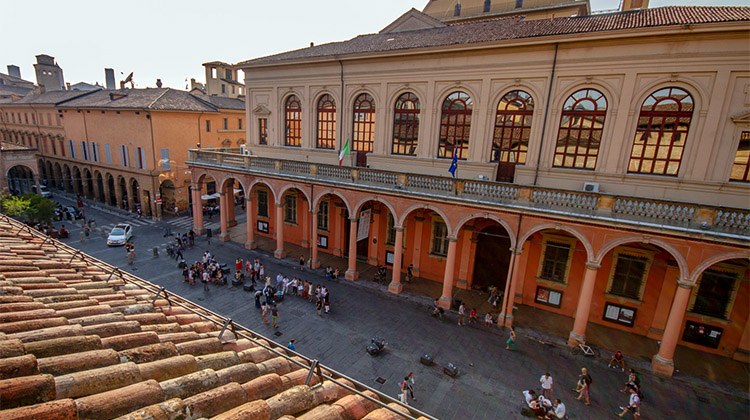
On 18 September 1988 in Bologna's main square (Piazza Maggiore), the Rectors of 430 universities signed the Magna Charta Universitatum Europaeum. The Magna Charta, which has since been signed by another 400 Rectors, affirmed the autonomy of the University, the essential link between teaching and research activities which transcend the limits imposed by "any geographical or political border". The signing took place as part of the ninth centennial of the University of Bologna, which was formally recognised as the Alma Mater of all universities.
The new campuses
Since 1989 until now, the Alma Mater has carried out the largest decentralisation programme in the history of Italian universities, establishing new University Campus branches in four towns in Romagna - Cesena, Forlì, Ravenna and Rimini. In 1998 the University also inaugurated a branch in Buenos Aires.
Reform of the European Univeristy System reform
On 19 June 1999 in the Aula Magna of the University of Bologna, 29 European Ministers of Higher Education signed the so-called Declaration of Bologna, which defines the "most relevant objectives for the creation of a European Area of higher education" and the promotion of this system in the world.
To meet these objectives European Union members must restructure their university systems by 2010, following the guidelines known as the Bologna Process.
Courses and enrolments
More than 100,000 students are enrolled at the University of Bologna, making our University one of the largest in Italy. Between Bologna, Forlì, Cesena, Rimini, Ravenna, Cesenatico, Faenza, Coviolo, Ozzano, and Imola there are over half a million square metres of floorspace for teaching and extra-curricular activities.
The 11 Schools offer 212 degree courses including 40 international degree courses.
The number of University Master's degrees grows each year: there are 61 currently active involving 700 instructors in high-level academic activities and contact with the professional world. Attention to carrier opportunities for future graduates has led the University to stipulate over 3500 agreements with businesses and public organisations thanks to which some 13000 students carry out a period of training in the working world each year.
International Mobility
According to a recent report by the National Committee for the Evaluation of the University System, the University of Bologna is today the most internationalised of all Italian universities.
The number of foreign students regularly enrolled is 2365, while another 2071 arrive every year on international mobility programmes such as Erasmus and Overseas.
Top of page
Libraries and Computing Services
Recent years have seen a rapid expansion of computing services. There are 87000 students linked to the university's e-mail service and 70000 computers connected to the university network.
Through the automised library service users can access a catalogue of 2400 online magazines 150000 ebooks and 500 database. The oldest Italian university is also one of the most technologically advanced.
Each month there are 3,5 milion accesses to the University's Web Portal which makes it the most visited university site in Italy. The service offered is of high quality, as shown by the the statistics of CENSIS.
In the Portal you can also find the latest issue of UniboMagazine, which expresses the point of view of the University on events and on the world of the university.